Mesothelioma Help Center - History Of Asbestos
Asbestos has been known to man for centuries and has been used in literally hundreds of products. Asbestos was used because it is strong, insulates well, and resists fire and corrosion.
The ancient Greeks used asbestos in their cloth and the Romans used it in their building materials. Common modern uses are as thermal pipe and boiler insulation, spray-applied fire proofing and sound proofing, floor coverings, ceiling tiles, roofing materials and "transite" pipe and sheeting
Ancient Greek geologist Strabo wrote in the first century about asbestos fiber, "which is combed out and woven, so that the woven material is made into towels, and, when these are soiled, they are thrown into fire and cleansed, just as linens are cleansed by washing."
Roman soldier and author Pliny the Elder also wrote about asbestos in the first century, "Is quite indestructible by fire," and "affords protection against all spells, especially those of the Magi."
Strabo and Pliny are widely reported to have made another observation that for centuries was largely forgotten: Lung problems arose among the slaves who were required to work in asbestos.
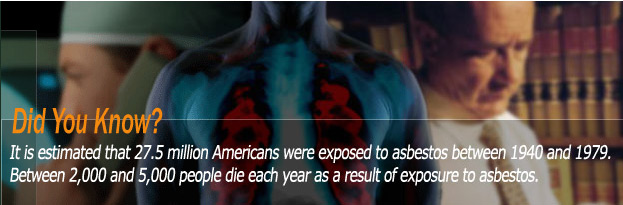
In the United States, asbestos became popular in the early 1900s and its use peaked during WWII into the 1970s. Workers by the hundreds of thousands were exposed to Asbestos and many have developed asbestos related diseases and many have died from asbestos exposure.
Over the last century it is estimated that over 30 million tons of asbestos was utilized in the construction of factories, office buildings, schools, shipyards, homes. It was used as fireproofing and insulation on industrial equipment such as boilers and turbines, and placed on millions of miles of piping. Even everyday items such as ironing boards, dryers, toasters, and low-density insulation products contained this wonder material.
By 1940 scientific studies that suggested a link between asbestos exposure and cancer had been published in medical journals. In 1955, scientists confirmed what had long been suspected---an unmistakable correlation between ingestion of asbestos fibers and the development of certain forms of lung cancer---what we now know to be Mesothelioma.
Despite the growing body of evidence regarding the serious health problems related to asbestos exposure, manufacturers and other continued to use it. Even though the manufacturers were probably aware of the potential health risks associated with asbestos exposure, they chose to ignore them. And these same companies also failed to use safer, alternative materials that were being developed. The victims were workers who and their family members who had no knowledge of the possible health risks they faced.
The lawsuits against the manufacturers and companies responsible for asbestos related cancer were brought as early as 1929. Since that time, asbestos litigation has yielded substantial monetary recovery for those workers and their family members afflicted with asbestos related diseases.
The Occupational Safety and Health Administration was created in 1971, and its first significant standard applied to asbestos. OSHA applied standards to both application and removal.
During the late 1960s, evidence emerged indicating that asbestos fibers were a dangerous health risk and by the 1970's, the federal government began to take action. During the 1980's, the concern regarding asbestos resulted in the new industry of asbestos abatement.
The only sure way to identify whether a material is asbestos (containing more than 1% asbestos) is to test the material using specific laboratory methods. Wisconsin state regulatory agencies use the Wisconsin State Laboratory of Hygiene, 2601 Agriculture Dr., Madison, WI 53718, phone (800) 446-0504. This lab will analyze samples for commercial and private use. Other labs may be listed in the Yellow Pages.
Insurers Knew About Asbestos Dangers, Reports Say
WASHINGTON, D.C. -November 14, 2003-Many insurance companies knew decades ago about the medical dangers posed by asbestos, but concealed that information from workers and the public, according to recent newspaper accounts ( Sacramento Bee, November 9, 2003 Minneapolis Star Tribune, Washington Bureau, November 9, 2003 , free registration required). For example, as early as 1931, a Metropolitan Life Insurance screening found that 42 of 195 Canadian asbestos miners had asbestosis , a severe respiratory disease caused by asbestos exposure, but the company never published the study. Dr. Anthony Lanza, Metropolitan Life's assistant medical director, even told Johns-Manville plant operators that there was no need to warn workers about asbestos hazards, according to company documents cited by the Star Tribune.
Metropolitan Life also minimized the seriousness of asbestosis in a U.S. report written in 1935. In the 1940s, it successfully squelched results of studies at the Saranac Laboratory in New York that linked asbestos exposure to lung cancer in mice. The record of Travelers Insurance is no better. Although it measured asbestos levels in factory air samples, and kept track of claims from workers who died or became ill from the substance, no public reports emerged from these figures, according to the news sources. Another insurance company, Liberty Mutual, monitored the use of asbestos in brakes and clutches in 1929. Liberty Mutual attributed death and illness to asbestos, but failed to report these findings.
The Star Tribune quoted from various internal insurance documents to highlight the insurance industry's knowledge of asbestos disease. "In 1900 medical research linked the mineral asbestos with asbestosis and 1935 brought the first direct linkage of asbestos to cancer," minutes of a 1976 meeting of the American Insurance Association said, according to the newspaper. An internal manual for Commercial Union Insurance Co., written in 1937, stated: "It is established that asbestos may cause disability and death, and that any well-defined case of asbestosis is very likely to progress to a fatal conclusion."
We help with you file Mesothelioma and Asbestos-related claims in each state
Call us toll free at 800.291.0963 or use quick contact form located at the right of this page and we will contact you within 24 hours.